
Preparing a Family Office for Succession

Solovis Insider
Key Takeaways
- Legal succession planning and operational succession are different problems, and most family offices have only solved the first one
- The knowledge a successor needs most sits in one person's head rather than in a system: the consolidated portfolio view, valuation basis, liquidity schedule, and risk baseline
- Cerulli projects $124 trillion transferring through 2048, and 87% of family offices have not yet been through a generational transition
- Only 35% of family offices have a defined succession plan for the office itself, separate from the estate plan
- The work of preparing an office for succession is sequential, can be run over four quarters, and ends with a rehearsal ahead of the transition
Ask a founder what their succession plan covers, and the answer is usually trusts, entity ownership, and who holds fiduciary authority once the transition happens. All of it necessary. None of it answers the question the successor actually faces in their first quarter: producing a defensible account of what the family owns, what it is exposed to, and what it has committed to fund, before the next capital call clears.
In a first-generation office, that account rarely exists in written form. It exists in the founder. Decades of decisions sit behind the current allocation, and the record of them is scattered across a custodial portal, a folder of general partner statements that arrive well after quarter end, a tax workpaper, and a spreadsheet whose formulas one person understands. The founder reconciles it in an afternoon because they remember why each piece is there. Nobody else reconciles it at all.
This is the gap that legal succession planning does not close, and it is a larger problem than most offices assume. Cerulli projects $124 trillion will transfer through 2048, and Bank of America found that 87% of family offices have not yet been through a generational transition. Yet UBS found that only 35% have a defined succession plan for the office itself, as distinct from the family estate plan. The entity and trust structure can be in order while the operational knowledge that makes the office function is still sitting with one person.
What a Successor Actually Needs
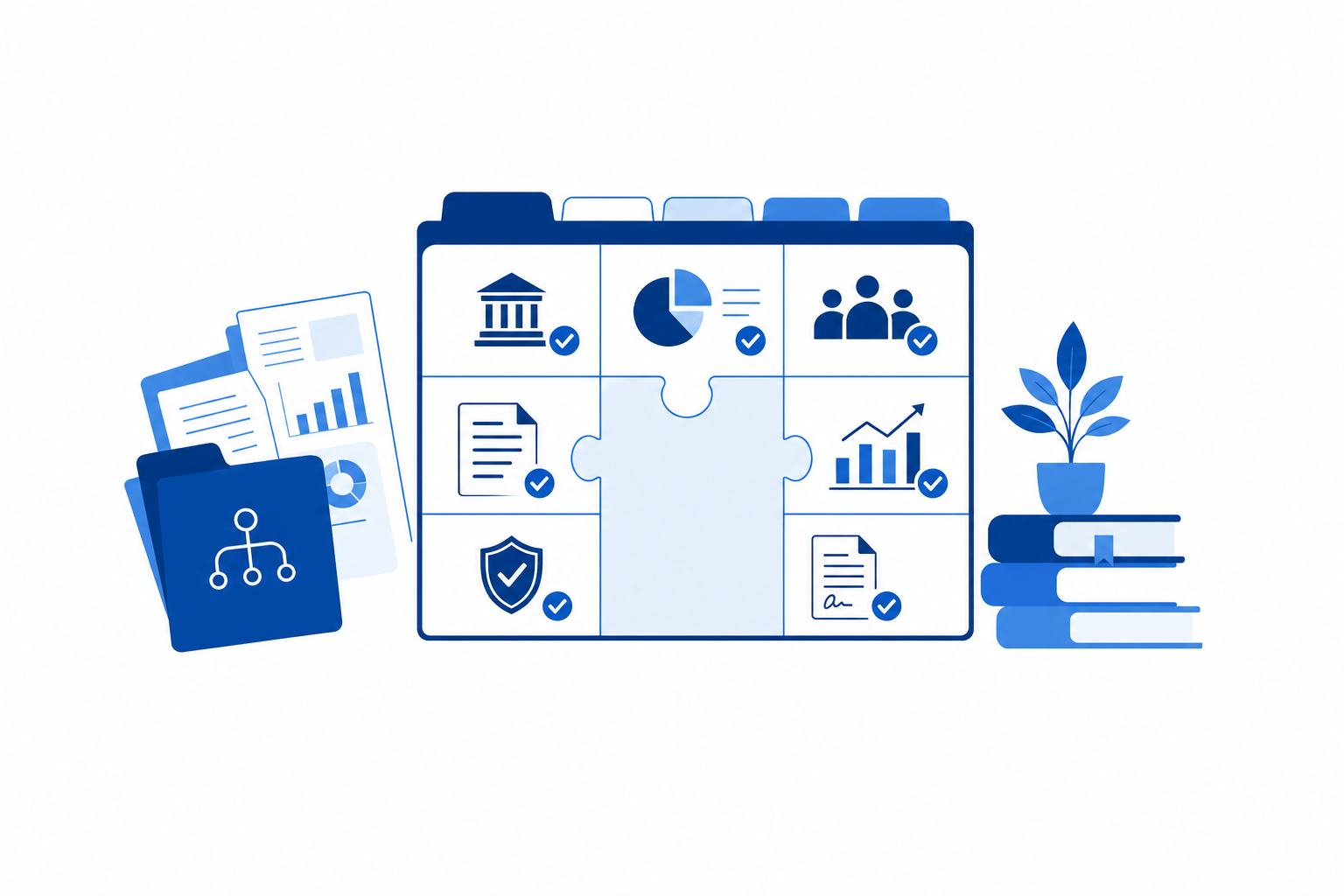
Four bodies of knowledge account for most of what a successor cannot reconstruct on their own, and each tends to sit with a single person for the same reason: it was never written down, only remembered. The consolidated view, every custodian, entity, account, and holding in one place, sits with the founder because they built the map. The valuation and carrying basis for illiquid positions reflects single decisions made years apart and applied by habit since. The commitment and liquidity schedule runs on pattern recognition: which funds call early, which general partners distribute slowly, how much cash to hold against both. The risk baseline gets described in committee rather than reported consistently, which makes it hard for a successor to tell a deliberate decision from drift.
None of this is a capacity problem. It is complexity that has never been moved out of one person's head. The founder can carry it because they built it, piece by piece, over a career. Nobody else was in the room for those decisions, so nobody else has the shortcut.
Moving the Knowledge Ahead of the Transition
Closing this gap is sequential work. It can be run in stages well before a transition date is set, and the last stage matters most: have the successor produce a full quarter of reporting from the system while the founder is leading the office and can review it alongside them. Whatever the successor cannot answer becomes a written exception, and every exception is a piece of knowledge that has not moved yet. An office that runs this rehearsal has tested its continuity. An office that skips it finds the gaps in real time, while a new decision maker is still learning the portfolio.
What This Requires of the Operating Platform
An office moving through this work needs a system that can carry these four bodies of knowledge. Solovis® Portfolio Analytics consolidates multi-asset exposure across public and private markets into one view. Risk Analytics and Solovis Risk Pro apply a factor lens to portfolio risk, so an incoming decision maker can see what is driving return without rebuilding the analysis each period. Predict models liquidity and commitment pacing forward, turning a private markets book from something one person tracked into a schedule the family, its advisers, and its committee can see and plan against.
The founder's knowledge can belong to the office rather than to one person. Building it into a system is what makes that true, and it is the natural last stage of building the institution.
Our full guide, Preparing a Family Office for Succession, walks through the readiness checkpoints, the four-quarter sequence, and the platform requirements that follow from it, along with the survey data behind each recommendation.
SOURCES
Cerulli Associates, U.S. High-Net-Worth and Ultra-High-Net-Worth Markets, 2024. Bank of America Family Office Study, November 2025. UBS Global Family Office Report 2026.
Talk to a Solovis expert