


From Theory to Practice: Breaking Down Three Barriers To A Total Portfolio Approach
-
The total portfolio approach (TPA) offers improved risk management and portfolio outcomes, yet most investors struggle to put it into practice.
-
Investment teams face three main barriers to implementing a total portfolio approach: limited access to a robust factor lens, holdings data availability, and difficulty implementing TPA within existing workflows.
-
Solovis Risk Pro addresses these challenges by delivering: (1) a factor lens that is both academically rigorous and easy to use, (2) a returns-based approach that works with existing allocator data, and (3) a modern cloud-based platform that enables a TPA to drive action.
-
With the right tools, allocators can begin seeing their portfolios through a factor lens in minutes – not months – gaining insights that complement traditional asset class frameworks while revealing risks and opportunities that might otherwise remain hidden.
You’ve just left an investment conference where a keynote speaker brilliantly outlined what could be the future of portfolio management. The "total portfolio approach" (TPA) focuses on a factor lens to analyze holistic risk and outcomes, rather than rigid asset class buckets.
But as the conference glow fades and you're back at your desk, reality sets in. Your spreadsheets are still organized by equities, bonds, real estate, and hedge funds. Your colleagues are still divided into asset class silos. A sophisticated factor lens was not included with the conference swag.
How do you actually go about implementing a total portfolio approach?
The TPA Implementation Gap
A factor lens is the foundation of a TPA and the core of Risk Pro’s design. It is the essential engine that powers the entire system. It is the common language used to analyze risk across and within all asset classes. Despite this critical importance, it is difficult for most institutional allocators to design and build themselves. Even more challenging is procuring, cleaning, and updating the necessary data. Without a robust factor lens, a TPA remains an academic theory rather than a practical reality.
Let’s explore three major barriers that prevent most investors from utilizing a total portfolio approach, and how Risk Pro addresses each one.
-
The Factor Lens Barrier: Building and Maintaining a Statistically Sound Lens
-
The Data Barrier: Analyzing Multi-Asset Portfolios Without Holdings Data
-
The Workflow Barrier: Implementing TPA Analysis Within Existing Workflows
The Factor Lens Barrier: Building and Maintaining a Statistically Sound Lens
In a perfect world, each investor would develop a tailor-made factor lens unique to their portfolio, with no two approaches being the same. But the universe of potential risk factors is essentially infinite and filled with statistical complexities, making it difficult to know where to start. Even for the most sophisticated institutions, building and maintaining a factor lens is rarely realistic given the time, cost, and expertise required.
While some factor lenses include hundreds of factors and are intended for granular and tactical decision making, research suggests that investors don’t need an overwhelming number of factors to manage their portfolios. Just as a nutritional label distills countless food compounds into essential components to manage human health, a practical factor lens should focus on the fundamental risks applicable to all portfolios.
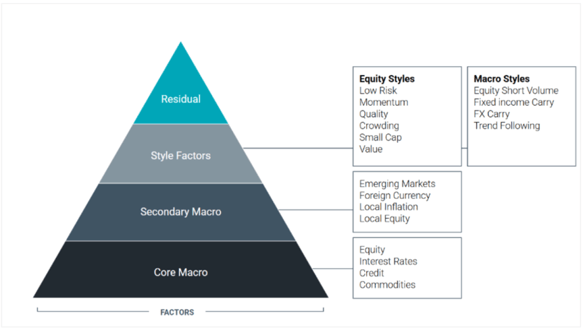
Like a well-designed nutrition label, the Risk Pro factor lens captures the essential information needed to understand portfolio outcomes in an intuitive way. Using just 18 factors, the lens has appeared to explain between 90% and 98% of return variation associated with typical institutional profiles.
This "less-is-more" approach achieves high explanatory power while helping investors see what matters. The result is a universally applicable global perspective that any investor can use.
Exhibit 1: The factor lens is a Less-Is-More Approach
Source: Solovis. For illustration purposes only.
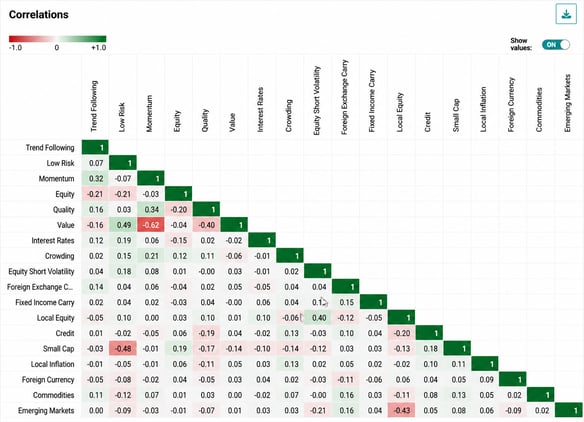
Equally challenging as factor selection is making sure that chosen risks work together efficiently. It is critical to seek broad independence between factors, otherwise, risk attribution becomes inaccurate, which can lead to imprecise allocation decisions.
The Risk Pro factor lens addresses this by ensuring factors maintain broad independence with each other (especially among macro factors) and implementing a tier system that consolidates overlapping risks into higher-tier factors. This provides allocators with a ready-to-use framework designed to produce intuitive, holistic, and academically rigorous insights. Whereas traditional asset class diversification often contains hidden correlations, a portfolio with exposure across various factors in the Risk Pro factor lens means diversification across truly independent sources of risk and return.
Exhibit 2: Uncorrelated Factors Lead to More Precise Allocation Decisions
Source: Solovis. Period from 8/7/1998 to 5/16/2025.
The off-the-shelf and ready-to-use nature of the Risk Pro factor lens effectively breaks down the factor lens barrier.
The Data Barrier: Analyzing Multi-Asset Portfolios Without Holdings Data
To conduct analysis that requires looking through to underlying positions, investment teams are reliant on fund managers sharing holdings in a transparent and timely manner.
For public equity and bond funds, allocators can conduct sophisticated analysis with few obstacles. But for hedge funds, SMAs, private assets, etc., allocators are often forced to rely on whatever limited analysis managers provide. This obstacle applies to holdings-based factor analysis as well, which is used by many providers. Without timely and transparent portfolio holdings data, holdings-based analysis can be a fragmented and inconsistent view of portfolio risk – the opposite of what a true TPA promises.
The Risk Pro factor lens was purpose-built to overcome this barrier through a returns-based approach. Rather than requiring hard-to-access holdings data, the regression-based methodology works with what allocators actually have: investment returns. Risk Pro supplies the factor return time series, making holistic factor analysis immediately accessible once investment returns are uploaded or accessed from the Risk Pro data library.
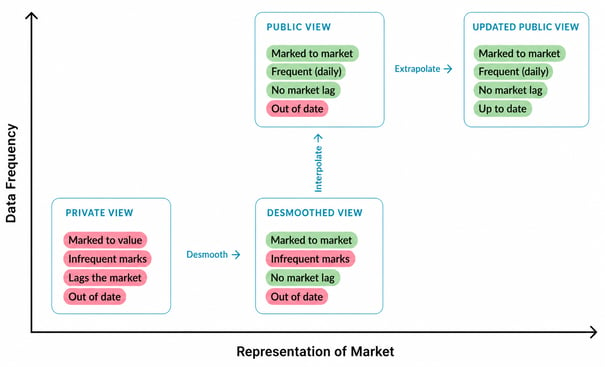
In cases where returns data is imperfect, techniques for enhancing it are readily available. For example, Risk Pro can implement proxy methods such as backfilling or interpolation to extend limited history or convert quarterly returns to daily. Extrapolation can be used to estimate the current value of an asset even if it is multiple quarters out of date, preventing one outdated position from limiting total portfolio analysis.
For private assets, time-weighted returns often exhibit artificially low volatility and lag behind public markets. Return desmoothing can adjust for these biases. By combining desmoothing with other proxying techniques, you can even bring private investments into the same analytical framework as liquid public assets, allowing them to be analyzed on equal footing – a critical requirement for any true total portfolio approach.
Exhibit 3: A Total Portfolio Approach Should Include Private Asset Solutions
Source: Solovis. For illustration purposes only.
A returns-based approach addresses the practical data reality for allocators, effectively breaking down the data barrier.
The Workflow Barrier: Implementing TPA Analysis Within Existing Workflows
Factor analysis can be easily trapped in static spreadsheets or complex systems that only quants can navigate. This creates bottlenecks where insights remain isolated rather than driving portfolio decisions across teams.
What’s more, when it comes to truly embracing a total portfolio approach, even the best analysis remains theoretical without practical implementation tools. A factor lens alone is not sufficient. It needs to be embedded in workflows that enable teams to collaborate, explore insights, and communicate findings effectively.
Risk Pro was designed specifically to overcome these workflow barriers through three key capabilities:
Seamless Collaboration Through Cloud Architecture: The cloud-based infrastructure of Risk Pro supports how investment teams work together on total portfolio analysis. When one team member creates a custom analysis or report, that intelligence is immediately available to everyone in the workspace. This shared knowledge environment eliminates duplicated efforts and ensures consistent analysis across the organization.
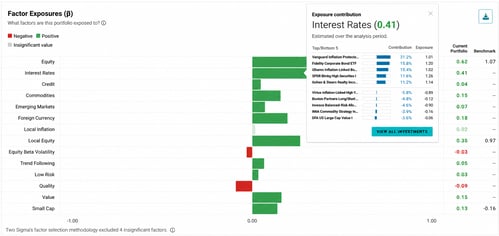
Interactive Visualization That Makes Factors Actionable: Understanding factor exposures is one thing. Knowing what to do about them is another. Risk Pro’s interactive interface allows users to instantly drill down from portfolio-level insights to individual contributors. For example, clicking on a potentially concerning Interest Rates factor exposure immediately reveals which managers or investments are driving that exposure, facilitating targeted decision-making rather than guesswork.
Exhibit 4: An Interactive UX Leads to Actionable Portfolio Insights
Source: Solovis. For illustration purposes only.
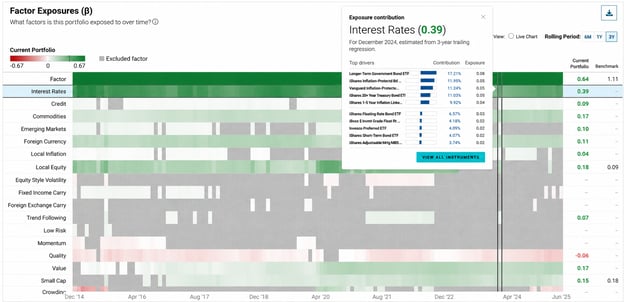
This interactivity extends throughout the Risk Pro platform, from rolling period analysis that reveals how active manager factor exposures change over time (Exhibit 5), to performance stress testing. Risk Pro’s interface transforms complex quantitative concepts into intuitive visuals that can help drive decision-making.
Exhibit 5: Visualizing Portfolio Evolution Through Factor Trend Analysis
Source: Solovis. For illustration purposes only.
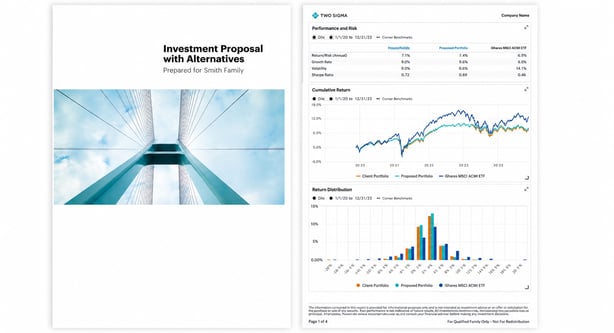
Comprehensive Reporting Beyond Just Factors: Effectively communicating a total portfolio approach is essential. Risk Pro’s Report Lab furthers this goal by transforming analyses into polished, professional communications that bridge the gap between technical details and stakeholder understanding.
The drag-and-drop nature of Report Lab allows teams to create custom reports that combine factor insights with traditional performance metrics, including the ability to incorporate management fees, custom disclosures, and your firm’s branding. In fact, templates go beyond deep dives into a portfolio’s factor profile. They can be geared toward manager due diligence, performance reporting, comparing current and proposed portfolios, etc.
This unified approach eliminates the typical workflow where analysis happens in one system but must be manually transferred to presentation tools, a process that introduces delays and potential errors.
Exhibit 6: A Seamless Transition from Analysis to Storytelling
Source: Solovis. For illustration purposes only.
Risk Pro’s design acknowledges that implementation is about more than just analytical capabilities. It is about making those capabilities accessible and actionable across investment teams. Risk Pro’s collaborative platform design effectively breaks down that typical workflow barrier.
Getting Started with a Total Portfolio Approach
Investment teams face three significant challenges to implementing a total portfolio approach: developing a robust factor lens, overcoming data limitations, and integrating factor analysis into everyday workflows. Rather than tackling each barrier in isolation, Risk Pro offers a comprehensive solution that addresses these challenges simultaneously.
By combining an academically rigorous yet accessible factor lens with a returns-based implementation, Risk Pro supports investment teams in moving from theoretical discussion to practical implementation, within a platform designed to integrate traditional and total portfolio workflows.
The journey to implementation is more straightforward than many believe. With the right tools, allocators can begin seeing their portfolios through a factor lens in minutes, gaining insights that complement traditional asset class frameworks while revealing risks and opportunities that might otherwise remain hidden.
Implementation is more accessible than many believe. Whether allocators are looking to transform their allocation process or add a complementary analytical lens, the tools now exist to turn portfolio thinking into portfolio reality.
Contact Solovis to learn more or request a demo.